The old PSLE grading system was a key part of Singapore’s education landscape for decades. Before the introduction of the Achievement Level (AL) framework in 2021, students were assessed using a T-score system that ranked their performance relative to their peers.
Many parents, educators, and former students still refer to the old PSLE grading system when discussing academic competition and secondary school admissions. Understanding how this system worked helps explain why Singapore’s Ministry of Education eventually replaced it.
How T-scores were calculated, how secondary school placement worked, the strengths and weaknesses of the system, and how it compares with the current PSLE scoring framework.
What Was the Old PSLE Grading System?
The old PSLE grading system was based on a statistical scoring method known as the T-score.
Unlike today’s Achievement Level system, students were not assessed solely on their individual marks. Instead, their results depended partly on how well other students in the cohort performed.
This meant that two students who achieved the same raw marks in different years could receive different final scores.
The system aimed to:
- Standardize results across subjects
- Differentiate students more precisely
- Support secondary school placement
- Rank students fairly within a national cohort
For many years, the T-score method served as the foundation of Singapore’s Primary School Leaving Examination.
The Purpose of the T-Score System
The T-score system was designed to account for differences in exam difficulty.
If a paper was particularly challenging, the scoring formula adjusted accordingly. Likewise, easier papers were moderated to maintain fairness across the cohort.
As a result, students competed not only against exam standards but also against one another.
How the T-Score Calculation Worked
One of the most discussed aspects of the old PSLE grading system was its complex calculation method.
The T-score measured a student’s performance relative to the average performance of all students taking the examination.
The calculation considered:
- Student’s raw marks
- Cohort average score
- Standard deviation of scores
- Subject-specific performance
A simplified formula was:
T-score = 50 + 10 × (Student Score − Mean Score) ÷ Standard Deviation
The T-scores from four subjects were then combined to produce an aggregate score.
Subjects Included in the Aggregate
Students received T-scores for:
- English Language
- Mathematics
- Science
- Mother Tongue Language
These scores were added together to generate a final aggregate score that usually ranged between 100 and 300.
Higher scores indicated stronger performance.
Example of T-Score Differences
Consider two students who both scored 85 in Mathematics.
Under the T-score system:
- Student A could receive a higher T-score if the exam was difficult.
- Student B could receive a lower T-score if many students scored similarly.
This created significant differences despite identical raw marks.
Why the Old PSLE Grading System Was Unique
The old PSLE grading system stood out because it ranked students against their peers rather than solely against fixed achievement standards.
This approach offered several benefits.
Advantages of the T-Score Model
Fine Differentiation
Schools could distinguish students using very small score differences.
For example:
- Student X: 251
- Student Y: 252
Such distinctions helped secondary schools allocate limited places.
Consistency Across Exam Years
The statistical approach adjusted for varying paper difficulty.
This made year-to-year comparisons more consistent.
Detailed Academic Ranking
The system provided a precise measure of student performance across the entire national cohort.
Challenges of the Old PSLE Grading System
Although effective in some areas, the old PSLE grading system also faced growing criticism.
Many educators and parents felt it encouraged excessive competition.
Increased Academic Pressure
Students often worried about losing valuable points due to tiny score differences.
A single mark could affect:
- School choices
- Admission opportunities
- Overall ranking
This created significant stress at a young age.
Peer Comparison Became Common
Since scores depended on cohort performance, students naturally compared themselves with others.
The focus often shifted from learning to ranking.
Limited Recognition of Achievement Bands
Two students with nearly identical academic ability could receive noticeably different T-scores.
Critics argued that such fine distinctions did not always reflect meaningful differences in learning outcomes.
Why Singapore Replaced the Old PSLE Grading System
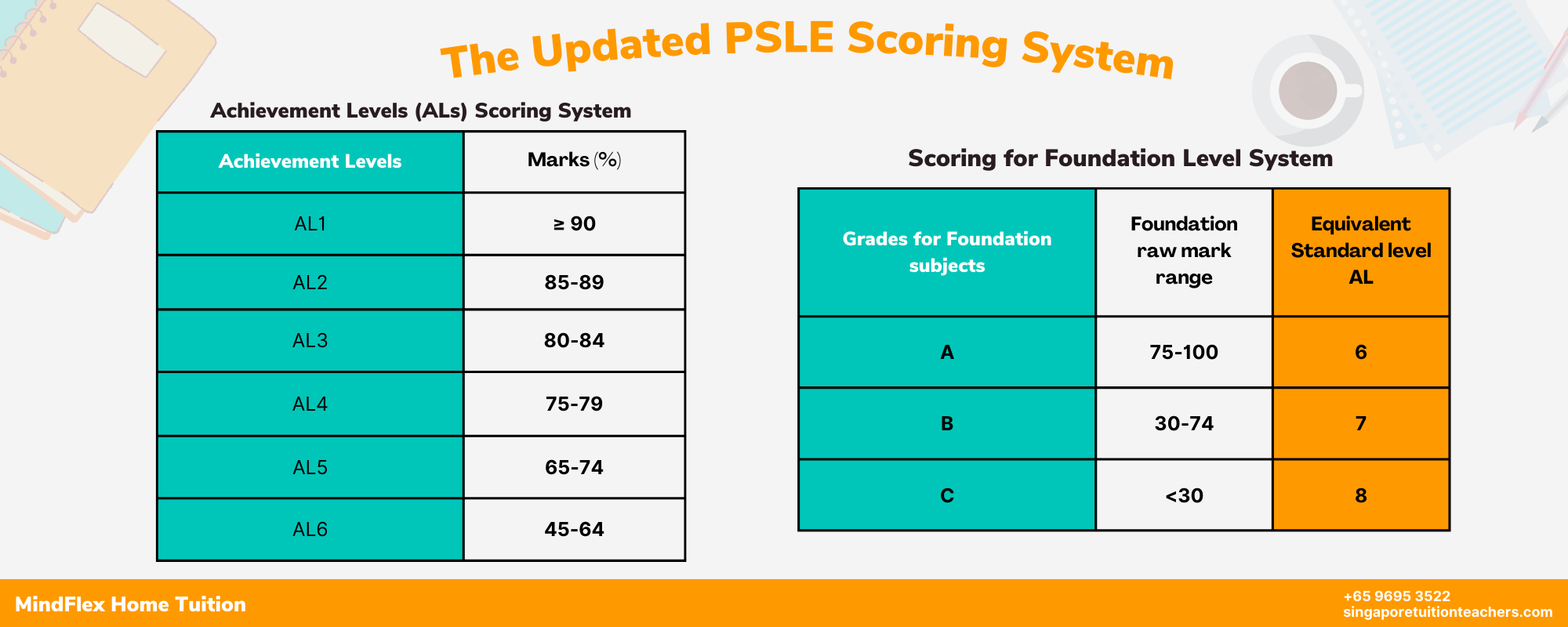
In 2021, Singapore introduced the Achievement Level (AL) framework to replace the T-score model.
The Ministry of Education aimed to reduce excessive competition and encourage more holistic learning.
The new system focuses on individual achievement rather than relative performance.
Key Reasons for the Change
The government identified several goals:
- Reduce fine score differentiation
- Lower examination stress
- Encourage broader learning outcomes
- Shift attention from ranking to mastery
The change represented a major milestone in Singapore’s education reforms.
Achievement Levels Replaced T-Scores
Under the new framework:
- Each subject receives an AL score.
- Students are graded against fixed standards.
- Peer performance no longer affects results.
This makes scoring easier for families to understand.
Old PSLE Grading System vs New AL System
Many parents still compare the old PSLE grading system with the current model.
The differences are significant.
| Feature | Old T-Score System | AL System |
|---|---|---|
| Assessment Basis | Relative performance | Fixed standards |
| Score Range | Around 100–300 | 4–32 |
| Competition Level | High | Lower |
| Peer Comparison | Required | Not required |
| Fine Differentiation | Extensive | Reduced |
| Introduced | Before 2021 | 2021 onwards |
Major Difference in Student Evaluation
The T-score model focused on ranking.
The AL framework focuses on achievement levels.
As a result, students who perform similarly are grouped within the same scoring band rather than being separated by very small numerical differences.
Impact on Secondary School Placement
Under the old PSLE grading system, secondary school admission depended heavily on aggregate T-scores.
Schools established cut-off points each year.
Students with higher aggregates generally had access to more competitive schools.
How School Selection Worked
After receiving results, students:
- Reviewed school cut-off points.
- Selected preferred schools.
- Submitted choices through the posting exercise.
- Received school placements based on scores and vacancies.
The process was highly competitive because even a one-point difference could influence admission outcomes.
Effects on Families
Parents often tracked historical cut-off points closely.
Tuition demand increased as families sought every possible advantage.
This contributed to concerns about academic pressure.
Lessons Learned from the Old PSLE Grading System
Although the system has been retired, it remains an important chapter in Singapore’s educational history.
Several lessons emerged from decades of experience.
Balance Matters
Academic excellence is important.
However, education systems must also support student well-being and personal development.
Assessment Shapes Behavior
When ranking becomes highly detailed, students naturally focus on competition.
Assessment methods influence how families approach learning.
Continuous Improvement Is Necessary
Education systems must evolve to meet changing societal expectations.
Singapore’s transition from T-scores to Achievement Levels reflects this ongoing process.
Frequently Asked Questions
1. What was the old PSLE grading system?
The old PSLE grading system used T-scores to rank students based on their performance relative to the national cohort.
2. How was the T-score calculated?
The T-score considered raw marks, cohort averages, and score distribution. Individual subject scores were combined into an aggregate score.
3. Why was the old PSLE grading system replaced?
It was replaced to reduce excessive competition, lower stress levels, and focus more on individual achievement rather than peer comparison.
4. When did Singapore stop using the T-score system?
Singapore officially replaced the T-score framework with the Achievement Level system in 2021.
5. Is the AL system easier than the old PSLE grading system?
Not necessarily. The academic standards remain rigorous, but the AL framework reduces fine score differentiation and excessive ranking.
Conclusion
The old PSLE grading system played a significant role in Singapore’s education system for many years. Through the T-score framework, students were ranked based on both their academic performance and their position within the national cohort. While the approach provided detailed differentiation and supported school placement decisions, it also contributed to intense competition and academic pressure.
The transition to the Achievement Level framework marked a shift toward recognizing learning achievement rather than small score differences. Understanding the old PSLE grading system remains valuable because it provides important context for Singapore’s educational evolution and helps parents appreciate the goals behind current reforms.
Whether you’re a parent, student, or educator, learning about these changes offers useful insights into how assessment systems continue to develop. Stay informed about education policies and assessment frameworks to make better academic decisions in the future.