Walk down Telok Ayer Street today and you’ll see office workers grabbing coffee, tourists snapping photos, and locals heading to lunch. It’s hard to imagine that this area was once Singapore’s shoreline. Yet right in the middle of this modern city stands Thian Hock Keng Temple, a place that tells the story of the people who helped build Singapore from the ground up.
Many Singaporeans know the temple by name, but fewer know why it matters so much. Beyond the beautiful rooflines and incense-filled halls lies a story of migration, faith, survival, and community. Whether you’ve walked past it dozens of times or are planning your first visit, understanding its history makes the experience far more meaningful.
What makes this historic temple special, what to look for during your visit, and why it remains one of Singapore’s most important cultural landmarks.
Why Thian Hock Keng Temple Matters So Much in Singapore’s History
The story of Thian Hock Keng Temple begins long before Singapore became the global city we know today.
In the early 19th century, thousands of Chinese immigrants arrived in Singapore by sea. Many came from China’s Fujian province hoping for a better life. The journey was long, dangerous, and often unpredictable.
When these immigrants arrived safely, they wanted a place to thank the deity they believed had protected them during their voyage: Mazu, the revered sea goddess.
That desire eventually led to the construction of this remarkable Hokkien temple on Telok Ayer Street.
At the time, the temple stood directly facing the sea. Newly arrived immigrants would often visit immediately after disembarking to offer prayers of gratitude. Today, land reclamation means the shoreline sits much farther away, but the temple remains exactly where history placed it.
The temple quickly became more than a place of worship.
It served as:
- A gathering point for the Hokkien community
- A social support center for newcomers
- A cultural hub for Chinese immigrants
- A symbol of shared identity and heritage
What this means is that the temple helped shape community life during Singapore’s earliest years.
The Meaning Behind the Name
Names often reveal more than we realize.
“Thian Hock Keng Temple” roughly translates to “Temple of Heavenly Happiness.”
The temple is dedicated primarily to Mazu, one of the most respected figures in Chinese folk religion. Known as the protector of sailors and fishermen, Mazu holds a special place in the hearts of coastal communities across Asia.
For immigrants making the dangerous voyage from China to Southeast Asia, faith in Mazu offered comfort and hope.
Even today, visitors can see worshippers offering prayers and incense to honor the goddess.
Who Is Mazu?
According to tradition, Mazu was born in Fujian province and became known for her compassion and ability to protect people at sea.
Over time, stories of miraculous rescues spread throughout Chinese coastal communities.
As migration increased, devotion to Mazu traveled with immigrants across the region, including Singapore.
This connection explains why the temple remains such an important religious site today.
The Architecture That Makes Visitors Stop and Stare
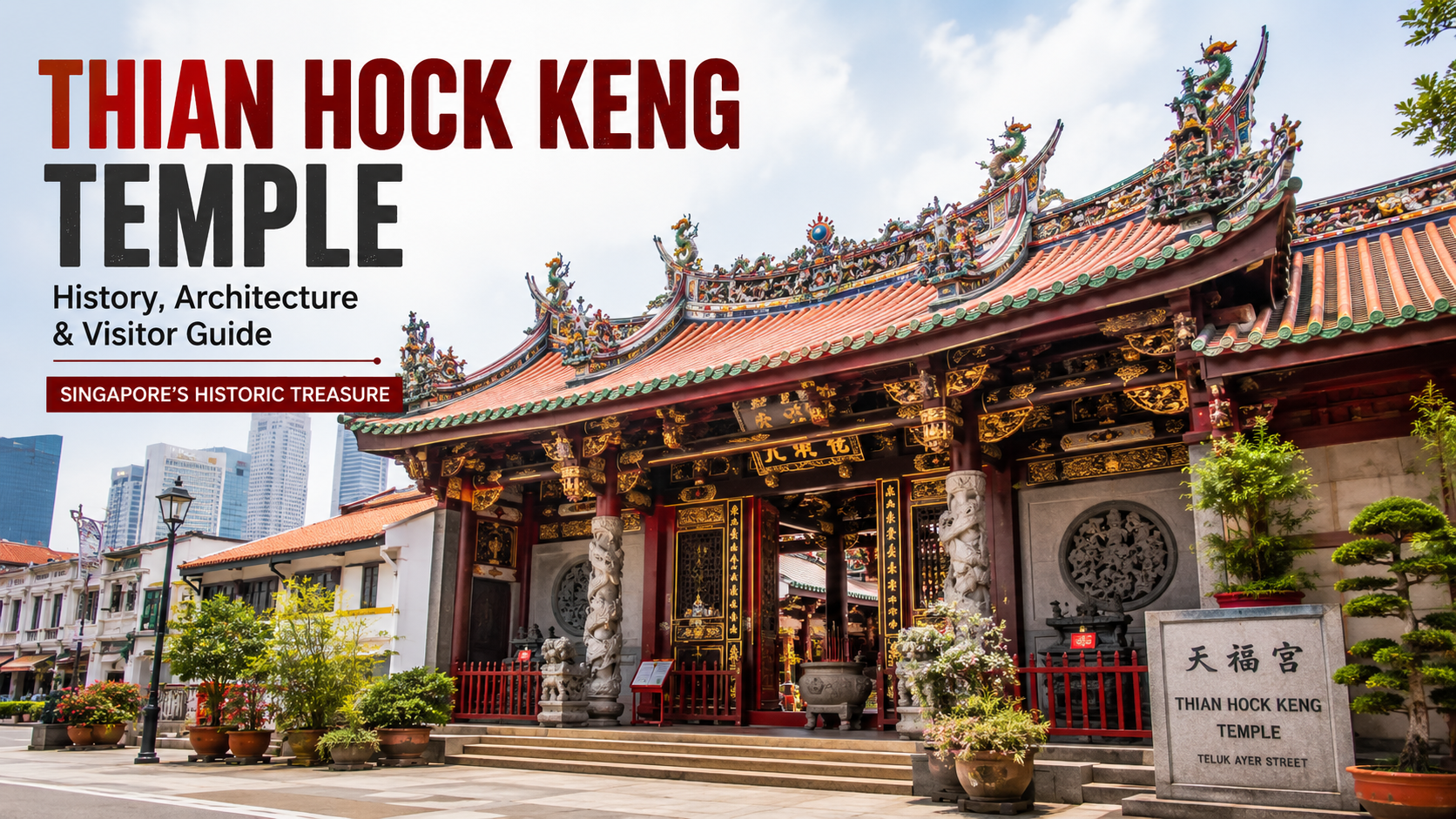
One of the first things you’ll notice is that the temple looks completely different from the modern buildings surrounding it.
That’s because it showcases authentic Southern Fujian architecture, a style rarely preserved at this level outside China.
Here’s where things get especially interesting.
The temple is widely known for being constructed using traditional techniques that relied heavily on interlocking wooden components rather than modern construction methods.
The result is an extraordinary example of traditional Chinese architecture that has survived for generations.
Look Up at the Roof
The roof is often the first feature visitors photograph.
You’ll notice:
- Curved roof ridges
- Detailed ceramic decorations
- Mythical creatures
- Elaborate dragon figures
These aren’t simply decorative.
In Chinese tradition, dragon carvings symbolize strength, protection, prosperity, and good fortune.
Many visitors spend time admiring the roof without realizing they’re looking at layers of cultural symbolism.
The Granite Pillars
Step closer to the entrance and you’ll see impressive granite columns.
These pillars were brought from China and feature intricate carvings that demonstrate the remarkable skill of traditional craftsmen.
Every detail reflects the influence of Fujian craftsmanship, which remains one of the temple’s defining features.
Courtyards and Layout
Unlike many modern buildings designed for efficiency, the temple layout creates a sense of calm.
Open courtyards allow natural light and airflow to move through the structure.
The arrangement encourages visitors to slow down, observe, and reflect.
That’s part of why the experience feels so different from the busy streets outside.
What to Look for During Your Visit
Many people walk through the temple in ten minutes and miss its most fascinating details.
If you’re visiting, take your time.
The Main Hall
The central hall houses the temple’s primary altar dedicated to Mazu.
This is the spiritual heart of the temple.
Observe the craftsmanship, incense offerings, and decorative details around the altar.
The Intricate Woodwork
Look closely at the beams and decorative panels.
You’ll find:
- Floral motifs
- Mythological scenes
- Traditional symbols
- Detailed carvings
The amount of hand-crafted work involved is astonishing.
Historical Plaques
Several plaques throughout the temple tell stories about donors, community leaders, and important events.
These details help connect the building to the people who supported it over the years.
The Quiet Corners
One of the best parts of visiting is simply sitting quietly for a few minutes.
You’ll often notice details you missed at first glance.
That’s especially true for locals who may have visited before but never really slowed down to explore.
The Restoration That Saved a National Treasure
Historic buildings don’t survive for nearly two centuries without care.
By the late 20th century, significant restoration work became necessary.
A major temple restoration project was undertaken using traditional conservation methods wherever possible.
Instead of replacing historic features unnecessarily, specialists worked to preserve original materials and craftsmanship.
The project became a model for heritage conservation.
In fact, the restoration earned international recognition through a UNESCO heritage award, highlighting the quality of the conservation effort.
For Singapore, this achievement demonstrated that rapid modernization and heritage preservation could coexist.
That’s an important lesson as the city continues to evolve.
Exploring the Telok Ayer Heritage District
One mistake many visitors make is treating the temple as a standalone attraction.
In reality, it’s part of a larger heritage trail packed with fascinating stories.
Once you’ve finished exploring the temple, spend time walking around the neighborhood.
Telok Ayer Street
This historic street played a major role in Singapore’s early development.
Many immigrant communities settled nearby, creating a rich cultural mix that shaped the area.
Singapore Chinatown
Just a short walk away, Singapore Chinatown offers:
- Historic shophouses
- Cultural attractions
- Traditional businesses
- Local food options
It’s easy to combine both destinations into a single afternoon outing.
Maxwell Food Centre
Feeling hungry?
Maxwell Food Centre is nearby and offers some of Singapore’s best-known hawker food.
Many locals pair a heritage walk with a meal here.
Ann Siang Hill
For a different atmosphere, head toward Ann Siang Hill.
The area combines historic architecture with modern cafes, bars, and boutiques.
It creates an interesting contrast between old and new Singapore.
Why the Temple Still Matters Today
Some people assume historic thian hock keng temple are only relevant to historians or religious devotees.
That’s not really the case.
The temple continues to serve several important roles.
First, it remains an active Taoist temple where worshippers gather regularly.
Second, it helps preserve Singapore’s Chinese heritage for future generations.
Third, it provides an opportunity for locals and visitors to better understand the immigrant stories that helped build modern Singapore.
In a city where change happens quickly, places like this provide continuity.
They remind us that today’s Singapore didn’t appear overnight.
It was built by communities who carried traditions, beliefs, and hopes across oceans.
Understanding that history makes the city feel more personal.
Practical Tips Before You Visit
If you’re planning a visit, keep these tips in mind.
Best Time to Visit
Morning hours are often quieter and more comfortable for exploring.
You’ll also enjoy better lighting for photography.
Dress Respectfully
As an active place of worship, modest attire is recommended.
Photography
Photography is generally permitted, but always remain respectful around worshippers.
How Long Should You Spend?
Most visitors spend between 30 and 60 minutes exploring the thian hock keng temple itself.
If you’re combining it with the surrounding heritage district, allow two to three hours.
Admission
Entry is typically free, making it one of Singapore’s most accessible cultural attractions.
Frequently Asked Questions
Why is Thian Hock Keng Temple famous?
Thian Hock Keng Temple is famous for being one of Singapore’s oldest and most historically significant Chinese temples. It was built by early Hokkien immigrants and remains an outstanding example of traditional Southern Fujian architecture.
What does Thian Hock Keng Temple mean?
The name translates roughly to “Temple of Heavenly Happiness.” It reflects the temple’s spiritual purpose and connection to traditional Chinese religious beliefs.
Who is worshipped at the temple?
The primary deity is Mazu, the sea goddess revered by sailors and coastal communities. Other deities are also honored within the temple complex.
Is Thian Hock Keng Temple worth visiting for locals?
Absolutely. Many Singaporeans know the thian hock keng temple exists but have never explored its history in depth. Visiting provides a deeper understanding of the city’s immigrant roots and cultural development.
How long does it take to visit Thian Hock Keng Temple?
Most visitors spend around 30 to 60 minutes at the temple. If you’re exploring the surrounding heritage district and Chinatown afterward, plan for several hours.
Final Thoughts
It’s easy to walk past historic buildings without giving them much thought. Yet Thian Hock Keng Temple offers something many attractions can’t: a direct connection to the people who helped shape Singapore’s identity.
From its roots as a gathering place for Chinese immigrants to its status as a cherished national monument, the thian hock keng temple continues to tell stories that matter. The architecture is impressive, the history is fascinating, and the surrounding neighborhood adds even more context to the experience.
The next time you’re near Telok Ayer Street, don’t just take a photo and move on. Step inside, look closely at the details, and spend a little time exploring. You’ll leave with a much richer understanding of Singapore’s past—and perhaps a greater appreciation for the communities that built its future.