
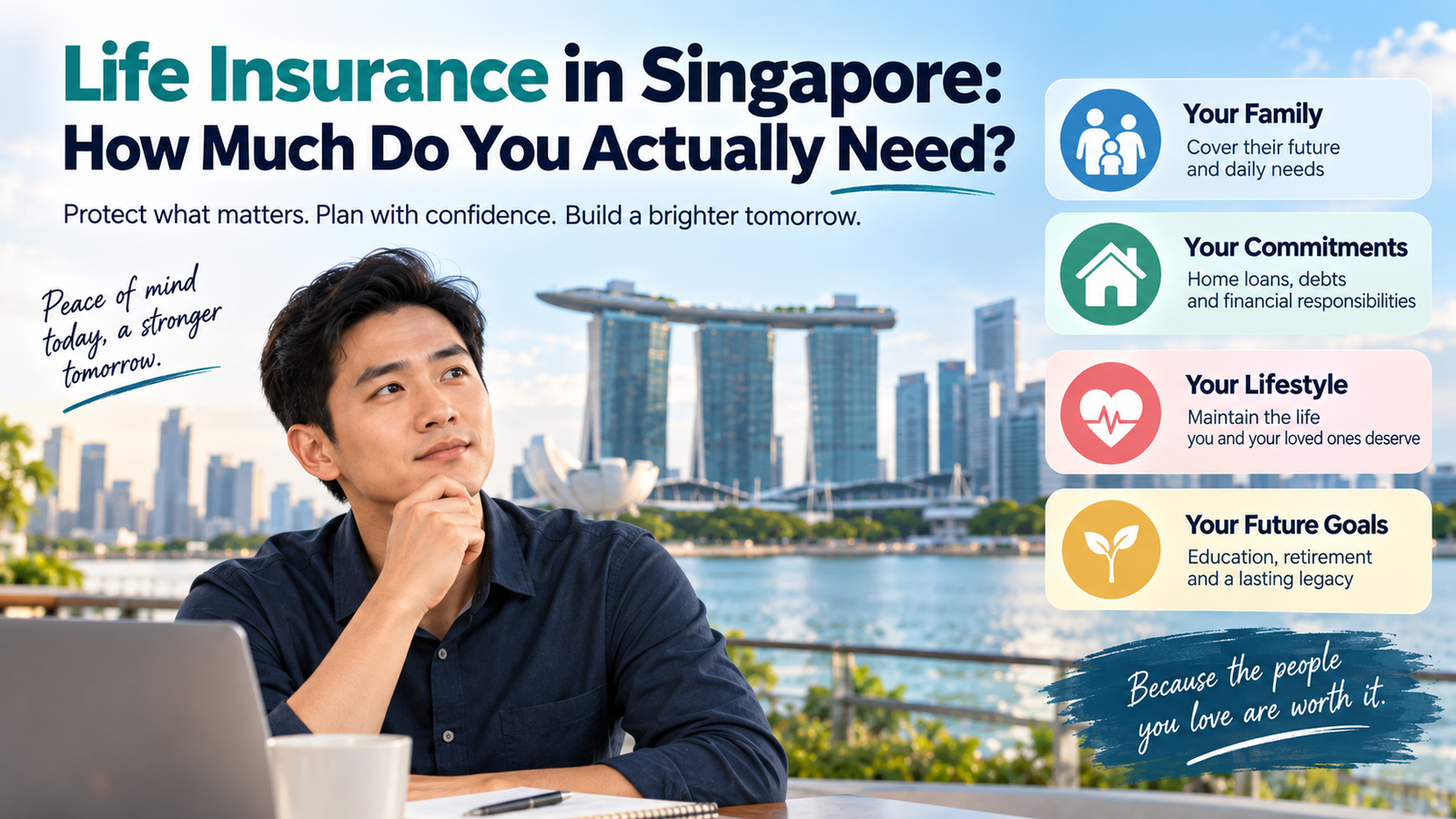
Life insurance is one of those things most people know they probably need, but working out how much to buy is less straightforward.
It is easy to start by looking at products and premiums. But before deciding between insurers or comparing term and whole life plans, there is a more important question to answer:
What financial problem are you trying to protect against?
For most people, life insurance is there to make sure the people who depend on them are financially secure if they are no longer around.
That means the right amount of life insurance can be very different from one person to another.
Do you need life insurance at all?
Not everyone needs a large life insurance policy.
The easiest way to think about it is to ask what would happen financially if your income stopped tomorrow.
If your spouse, children or parents depend on your income, life insurance can help replace some of that income and give your family time to adjust.
You may also need coverage if you have debts that would otherwise become someone else’s responsibility, such as a mortgage.
On the other hand, if nobody depends on you financially, you have no significant debts and you already have sufficient assets, your need for life insurance may be much lower.
This is why buying life insurance should start with your personal circumstances rather than a particular product.
What should your life insurance cover?
A useful starting point is to think about the financial commitments that would remain if you passed away.
These could include:
Your family’s living expenses
If you are responsible for a large part of the household income, how much would your family need to continue paying for everyday expenses?
It does not necessarily mean replacing every dollar of your income for the rest of their lives. Instead, consider how long your dependants are likely to need support and what other sources of income they would have.
Outstanding loans
A mortgage is often one of the largest financial commitments a household has.
You may already have some mortgage protection, particularly if you own an HDB flat and are covered under the Home Protection Scheme. But it is still worth checking what is covered and whether there are other loans your family would have to deal with.
Your children’s future expenses
For parents, life insurance may also be intended to provide for children’s education and living expenses until they become financially independent.
A family with a two-year-old child will therefore usually have a different protection need from parents whose children have already started working.
Other people who depend on you
Financial dependants are not always children.
Some people support ageing parents, while others may be responsible for a sibling or another family member.
These commitments should be considered when deciding how much protection you need.
Check what life insurance you already have
Before buying another policy, look at the protection that is already in place.
Many Singaporeans may already have some coverage through CPF schemes or their employer.
For example, the Dependants’ Protection Scheme provides basic term life protection to eligible CPF members. Homeowners may also have protection for their HDB loan through the Home Protection Scheme.
Your employer may provide group life insurance as part of your employee benefits as well.
These are useful forms of protection, but they may not cover everything you need. Employer coverage can also disappear when you change jobs.
The objective is therefore not to ignore existing coverage, but to count it when working out your remaining insurance gap.
Term life or whole life?
Once you know roughly how much protection you need, the next question is often what type of life insurance to buy.
The two most common options are term life and whole life insurance.
Term life insurance provides protection for a fixed period, such as 20 or 30 years, or until a particular age. It generally provides a higher amount of insurance coverage for a lower premium because it is primarily designed for protection and does not build cash value.
This can work well for financial responsibilities that have an end date.
For example, parents may want higher coverage while their children are young and still financially dependent on them. Someone with a large mortgage may similarly need more protection during the years when the outstanding loan is highest.
Whole life insurance is intended to provide lifelong coverage and usually builds some cash value over time. Because of this, premiums are generally higher for the same amount of protection.
Whole life may suit people who want a portion of their coverage to remain for life or who have financial needs that are not expected to disappear when they retire.
There is no rule saying you must choose one or the other.
Some people use a combination: a smaller whole life policy for lifelong protection together with term insurance providing additional coverage during the years when their financial responsibilities are highest.
Don’t confuse life insurance with critical illness insurance
Another common source of confusion is treating all insurance that pays a lump sum as the same thing.
Life insurance is primarily intended to protect the people who depend on you if you pass away.
Critical illness insurance solves a different problem.
If you become seriously ill but survive, your household may still lose income while you undergo treatment or take time away from work. Critical illness coverage can provide a lump-sum payout that you can use for living expenses, additional treatment or other financial commitments.
Hospitalisation insurance serves another purpose again: helping to pay eligible medical bills.
A good protection plan therefore considers these risks separately rather than assuming one policy covers everything.
How much life insurance is enough?
There are many rules of thumb, such as buying insurance equivalent to a certain number of years of income.
They can provide a quick reference, but they should not replace an actual calculation.
Someone earning S$100,000 a year with no dependants and no debt may need less life insurance than someone earning S$70,000 who supports two young children, ageing parents and a mortgage.
A more useful approach is to add up what your family would need, subtract the assets and insurance you already have, and insure the remaining gap.
Your needs will also change.
Buying a home, getting married, having children or taking responsibility for ageing parents can increase the amount of protection you require. Paying off your mortgage or having children become financially independent may reduce it.
Life insurance therefore should not be something you buy once and never look at again.
Compare the coverage, not just the premium
Once you know what you need, you can start comparing policies.
Price matters, particularly because life insurance can be a long-term financial commitment. But two policies with similar premiums may not necessarily provide identical protection.
Look at the amount of coverage, how long it lasts, what events trigger a payout, exclusions and any optional benefits included with the policy.
If you are comparing several options, resources such as Planner Bee’s life insurance guide can help you understand how life insurance works in Singapore and the differences between term and whole life coverage before comparing individual plans.
Planner Bee compares insurance options across multiple insurers, allowing consumers to research their choices before deciding whether they need further advice.
Buy enough, but don’t buy blindly
The purpose of life insurance is not to own as many policies as possible.
It is to make sure that if something happens to you, the people who rely on you do not suddenly face a financial problem on top of everything else they are dealing with.
Start with the people you are protecting. Work out what they would need. Account for what you already have. Then compare the available options.
That usually leads to a much better decision than starting with whichever life insurance policy happens to be advertised to you first.